


The Best Furniture for Panama’s Climate: What Lasts, What Fails
An expert guide to furniture materials for Panama’s tropical climate — the woods, stone, metals and fabrics that survive humidity, salt, UV and termites, and what to avoid.

In most of the world, choosing furniture is about looks and price. In Panama it is about survival. Nine degrees north of the equator, your furniture is under attack on five fronts at once, year-round — and the pieces that photograph beautifully in a Miami or Madrid showroom are often the first to fail here. This is the guide we wish every new arrival had before they furnished a home in the tropics.
Why Panama is so hard on furniture
Five stressors, all at the same time:
- Humidity & rain. Relative humidity commonly runs 75–90% (peaking near 88% in June), with roughly 1,900 mm (75 in) of rain a year. Wood is hygroscopic — it swells and shrinks as it trades moisture with the air. Move a piece between a humid hallway and an air-conditioned room and that cycling warps doors, cracks panels and pops joints.
- Coastal salt air. Airborne chloride makes metal corrode 10–50× faster than inland, and holds moisture against every surface. Panama City’s bayfront and both coasts sit squarely in this zone.
- Intense UV. Near-vertical equatorial sun fades dyes, greys unfinished wood and turns cheap plastics brittle.
- Termites (“comején”). Subterranean species (Coptotermes, native Nasutitermes) and drywood termites that infest furniture directly — eating the cellulose inside a piece while the surface still looks intact.
- Mould & wood-boring beetles. Fungi colonise almost any organic surface above ~70% humidity; borers reduce susceptible wood to powder.
The lesson: in Panama, biological durability and moisture stability — not looks — decide what survives.
Wood: what lasts, what fails
A wood survives the tropics through three things: natural oils/extractives that repel water and deter insects, high density (tight grain resists penetration and moves less), and sometimes silica that blunts insect mandibles. Only the heartwood carries this — sapwood is always vulnerable.
Woods that last: Teak (the benchmark — high oil plus up to ~1.4% silica), cumaru and ipe (extreme density and extractives), guayacán / lignum vitae (the densest traded wood, essentially rot- and insect-proof), and Spanish cedar (cedro) — lighter, but its aromatic oils actively repel insects (the classic wardrobe and humidor wood).
Woods that fail: pine and softwoods (termite candy); oak, maple and other temperate hardwoods (dimensionally unstable and not termite-resistant); and worst of all, MDF, particleboard and ‘hidrófugo’ board — wood fibres bonded with glue that act like microscopic sponges. In humidity the fibres swell, then the water dissolves the glue: irreversible swelling and delamination, often within 2–3 wet seasons. A local rule of thumb we agree with: avoid MDF even when it is labelled ‘hidrófugo’. Only true marine-grade plywood belongs anywhere near moisture.
Stone: durable, but know the trade-off
Stone doesn’t rot, warp or feed termites — its enemies are staining, etching and the humidity that lives in its pores. Marble, travertine and onyx are porous and acid-sensitive: they stain and etch (dull spots) on contact with citrus, wine or the wrong cleaner, and want re-sealing every 6–12 months here. Sealing reduces staining but does not prevent etching. They are perfect on lower-contact pieces — console and side tables, vanities — where their beauty carries the room. Granite is denser and the most forgiving for daily-use surfaces. Whatever the stone, keep the base and underside ventilated so trapped humidity doesn’t breed mould. (We build in genuine marble, travertine and onyx, and brief every client on care.)
Metal: aluminium wins, iron loses
Aluminium (UV-resistant powder-coated) is the best all-round frame metal — its self-healing oxide layer shrugs off salt air. Marine-grade 316 stainless is excellent near the coast (use 316, not 304). Brass/bronze won’t rust but patinas in salt air. Iron and plain carbon steel are the worst — thin frames can rust through within a few years of salt exposure. The closer to the water, the more you move toward aluminium and 316.
Upholstery: why leather moulds, and what to use instead
Leather is organic and porous; above ~70% humidity mould feeds on it, so it belongs only in air-conditioned interiors (~40–55% RH) with conditioning and airflow. The winners are performance fabrics that don’t absorb water or feed microbes: solution-dyed acrylic (Sunbrella — colour locked through the fibre, superb UV life) and olefin. Just as important is the fill: use quick-dry (reticulated) foam so cushions drain and dry from the inside rather than becoming mould reservoirs.
Wicker: HDPE, never natural (outdoors)
Natural rattan absorbs moisture, swells, moulds and grows brittle — indoor, air-conditioned rooms only. For terraces, insist on HDPE (high-density polyethylene) resin wicker with UV stabilisers blended through the strand, over an aluminium or 316 frame. Avoid cheap PVC wicker, which cracks and fades in a few tropical seasons.
Three environments, three sets of rules
- Air-conditioned interior (40–55% RH): the only place for leather, natural rattan and fine veneers. Keep humidity steady — swinging between a sealed A/C room and a humid hall is what cracks wood.
- Covered terrace: tropical hardwood, aluminium/316, HDPE wicker, sealed stone, performance fabric. No leather, no MDF, no natural rattan, no iron.
- Fully exposed (sun + rain + salt): the harshest tier — teak or ipe, aluminium/316, HDPE wicker, sealed dense or sintered stone, solution-dyed acrylic on reticulated foam, plus fresh-water rinses and covers.
The through-line
Longevity in Panama comes from choosing materials that are inherently moisture-stable, biologically inedible and UV/salt-resistant — and then reserving the beautiful-but-vulnerable ones (leather, natural rattan, fine veneers) strictly for air-conditioned rooms. This is exactly how we design at Marcelina: a Panama studio that builds every piece to order in climate-correct materials, sized to your space and delivered white-glove — no MDF, no import gamble.
Furnishing a Panama home? → Read the full relocator’s guide, weigh up shipping vs. buying, or book a consultation.
Frequently asked questions
What furniture materials last in Panama's climate?
The materials that are inherently moisture-stable, biologically inedible and UV/salt-resistant: dense oily tropical hardwoods (teak, cumaru, ipe, guayacán, Spanish cedar), powder-coated aluminium and marine-grade 316 stainless steel, sealed dense stone, HDPE (UV-stabilised) resin wicker, and solution-dyed performance fabrics like Sunbrella over quick-dry foam. Everything else is either maintenance or a mistake.
What furniture should you avoid in Panama?
Anything organic and absorbent or dimensionally unstable: MDF, particleboard and even ‘hidrófugo’ (moisture-resistant) board — the worst choice, they swell and delaminate within 2–3 wet seasons; pine and softwoods (termite food); temperate hardwoods like oak that move and rot; leather, natural rattan and cotton/linen outside air-conditioning; and iron or plain powder-coated steel near the coast.
Does leather furniture survive in Panama?
Only in a climate-controlled interior held around 40–55% relative humidity, with regular conditioning and airflow. Leather is organic and porous — above ~70% humidity, mould colonises and feeds on it. On an un-air-conditioned space or near the coast, expect it to mould, often within a year or two.
Which woods resist termites and humidity?
Dense tropical hardwood heartwood with natural oils: teak (high oil plus silica), cumaru, ipe, guayacán/lignum vitae, and Spanish cedar (cedro), whose aromatic oils actively repel insects. Only the heartwood is durable — sapwood of any species is vulnerable, and pine/oak are not naturally resistant.
Is marble or travertine a good idea in a humid climate?
Yes, if you understand the trade-off. Stone doesn't rot or warp, but marble, travertine and onyx are porous and acid-sensitive — they stain and etch, and need re-sealing every 6–12 months in Panama's humidity. They shine on lower-contact surfaces (console and side tables, vanities) and should be blotted immediately after acidic spills. Granite is denser and more forgiving.
What outdoor furniture survives Panama's rain, sun and salt?
On a terrace: tropical hardwood (teak/ipe), powder-coated aluminium or 316 stainless steel frames, HDPE resin wicker, sealed dense stone or sintered slab tops, and solution-dyed acrylic cushions on quick-dry (reticulated) foam. Elevate everything on feet, keep airflow underneath, and rinse coastal metal with fresh water.
By Marcelina Funk, Founder — Marcelina Furniture Studio, Panama
From our workshop
132 pieces · View all →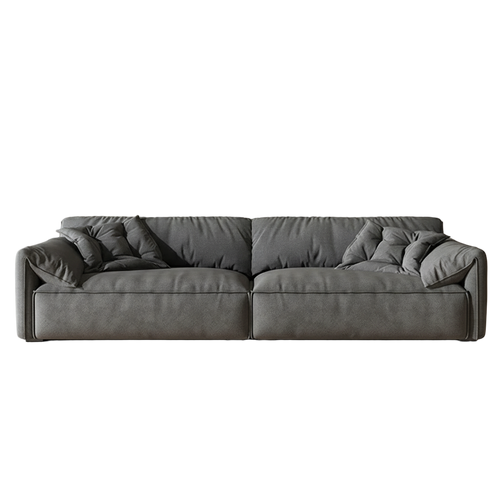 The Lune SofaStarting at $555.00 Member / $740.00 Regular
In stock
The Lune SofaStarting at $555.00 Member / $740.00 Regular
In stock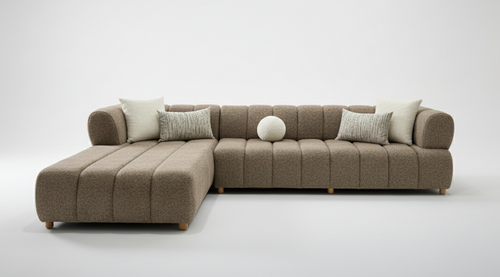 The Bréhat Sectional SofaStarting at $1,575.00 Member / $2,100.00 Regular
In stock
The Bréhat Sectional SofaStarting at $1,575.00 Member / $2,100.00 Regular
In stock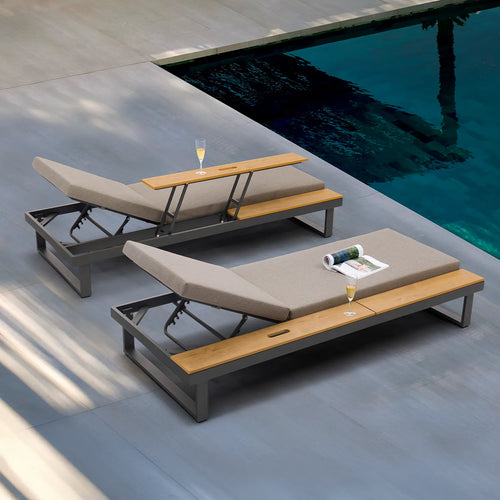 The Belluno Sun LoungerStarting at $2,145.00 Member / $2,860.00 Regular
In stock
The Belluno Sun LoungerStarting at $2,145.00 Member / $2,860.00 Regular
In stock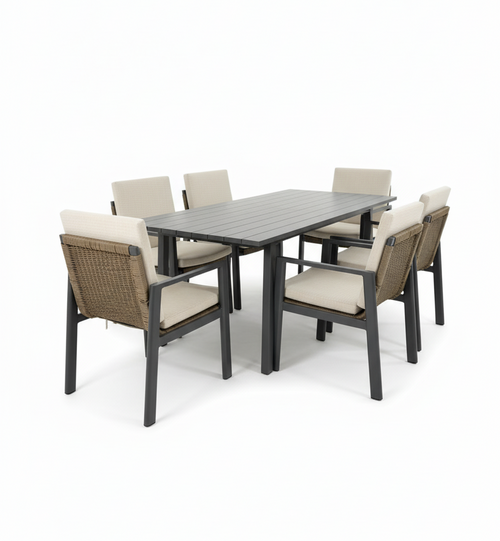 The Golfe-Juan Outdoor Dining SetStarting at $1,650.00 Member / $2,200.00 Regular
Tell us what you imagine. We build it.
Designed with you, built in our own workshops, delivered white-glove across Panama and the US.
Book a Consultation WhatsApp