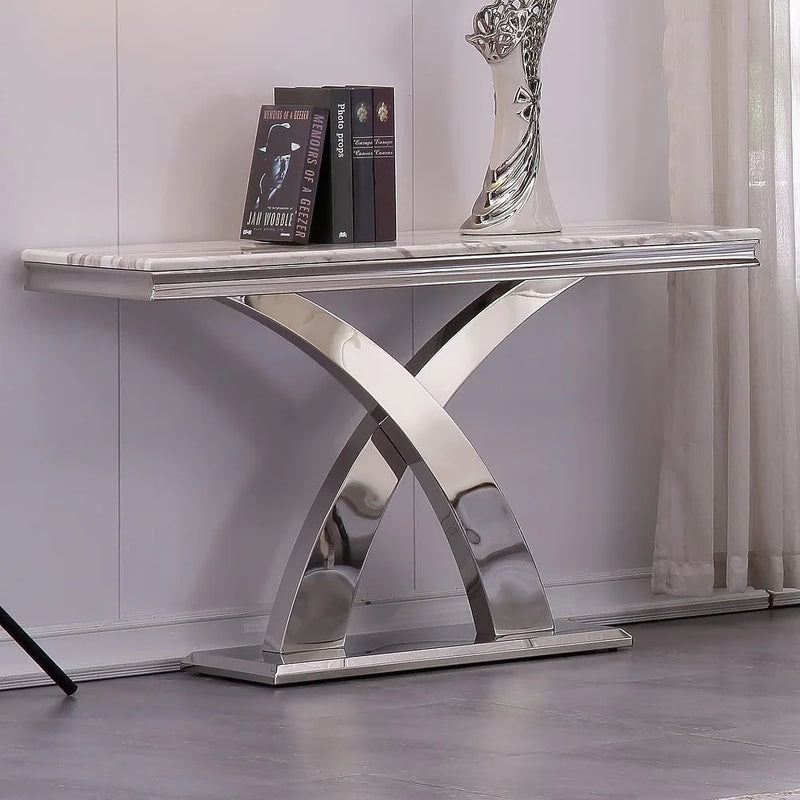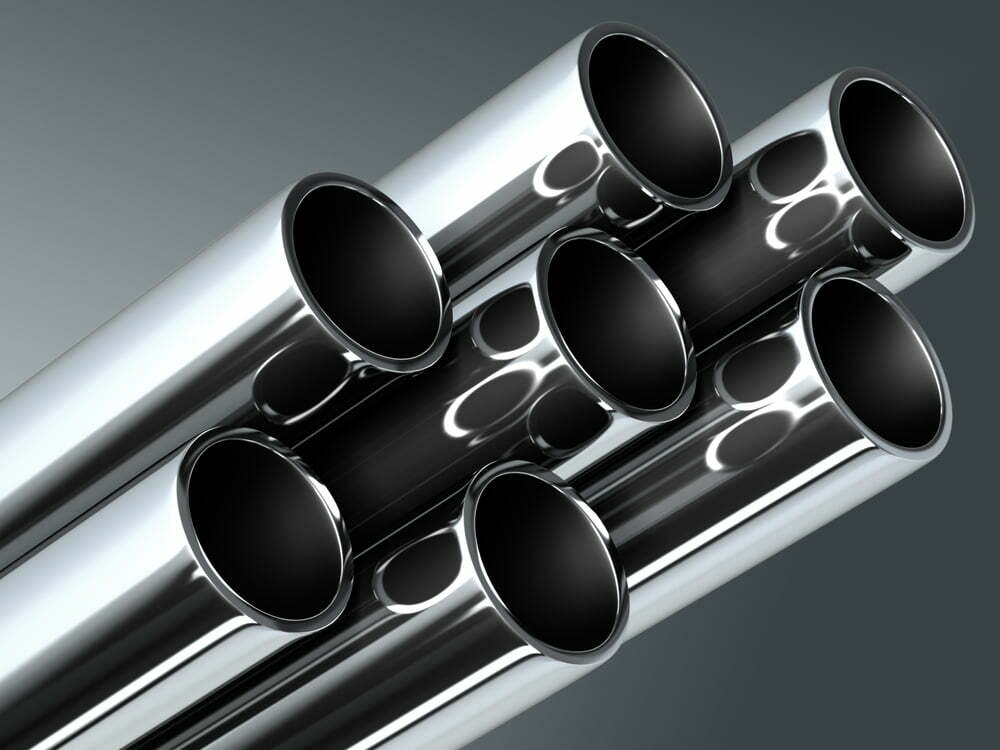
Stainless steel is the premium structural metal in furniture — heavier, stronger, and more visually refined than aluminium, with a material presence that reads as quality the moment you encounter it. A stainless steel frame has a density and rigidity that no powder coated alternative can replicate, and a surface that ranges from a mirror polish to a subdued brushed finish depending on specification.
The stainless grades used in quality furniture are typically 304 (18/8 — 18% chromium, 8% nickel) for indoor and moderately sheltered outdoor use, and 316 (marine grade — with added molybdenum) for exposed coastal or marine environments. Both are corrosion resistant under the majority of conditions; 316 provides meaningful additional resistance to chloride attack from salt air or pool chemicals.
Stainless steel commands a significant price premium over both powder coated aluminium and painted steel — a premium that is justified by longevity, aesthetic quality, and structural performance. For statement indoor pieces, high-specification outdoor furniture, or commercial installations where the material character of the frame is as important as its function, stainless steel is the correct specification.
How Stainless Steel Furniture Frames Are Made
Furniture-grade stainless steel frames are fabricated from tube, flat bar, rod, or sheet steel depending on the design. The material is cut, bent, and welded — typically TIG (tungsten inert gas) welded, which produces clean, precise welds that can be ground and polished to invisibility on high-specification pieces. The quality of the welding and post-weld finishing is one of the primary visible quality differentiators in stainless steel furniture.
Stainless steel does not require a protective coating to resist corrosion — its corrosion resistance is intrinsic to the alloy. The chromium in the steel forms a passive oxide layer on the surface that is self-repairing: if the surface is scratched, the oxide layer reforms in contact with oxygen. This is a fundamental difference from aluminium or iron, where a coating or treatment is protecting the underlying metal rather than the metal protecting itself.
Tube & Solid Construction
Most furniture frames use hollow tube sections — square, rectangular, or round — which provide excellent structural rigidity at lower material weight than solid bar. Legs and structural members in tube form are standard. Solid round or square bar is used for decorative details, feet, and smaller elements where the solid section adds visual weight.
TIG Welding & Weld Finishing
TIG welding produces clean, precise joints with minimal spatter. On visible external joints, the weld is subsequently ground back, filled if needed, and polished to match the surrounding surface finish. On high-specification pieces, the weld joints are entirely invisible — the result looks cast rather than fabricated. This finishing work represents a significant proportion of the production cost of quality stainless furniture.
Bending & Forming
Stainless steel can be bent to precise radii using tube bending equipment. Consistent radius bends in square or round tube — chair legs, frame arches, sled bases — require accurate tooling and are a test of manufacturing precision. Inconsistent radii or kinks at bend points are quality failures that are immediately visible in the finished piece.
304 vs 316 — Which Grade to Specify
For indoor furniture and covered or semi-sheltered outdoor applications in non-coastal environments, 304 stainless steel is entirely adequate and the standard specification. For furniture in direct coastal exposure — salt spray, marine environments, poolside with regular chlorinated water contact — 316 grade provides meaningful additional chloride resistance and is worth the modest additional cost. Specifying 316 for an inland indoor piece is unnecessary; specifying 304 for a beachfront terrace is a quality compromise.
Stainless Steel Surface Finishes
Unlike powder coated aluminium where colour is the primary finish variable, stainless steel finish options are primarily about surface texture and reflectivity — from mirror-polished to matte brushed. Colour options exist through PVD coating but involve a different process.
Brushed / Satin (No. 4)
The most widely used stainless finish for furniture. Directional linear grain produced by abrasive finishing — subtle, refined, and practical. Brushed stainless hides fingerprints and minor scratches significantly better than polished finishes. The standard specification for dining frames, table bases, and structural furniture elements.
Mirror Polished (No. 8)
A fully reflective, near-mirror surface produced by progressive polishing stages. Visually dramatic and clearly premium in character, but demanding in maintenance — fingerprints, water marks, and fine scratches show immediately and require regular attention. Appropriate for statement pieces in controlled indoor environments; demanding in hospitality settings.
Matte / Bead Blasted
A fine, uniform matte texture produced by bead blasting. Softer in appearance than brushed stainless, with no directional grain. Reads less like conventional stainless steel and more like a refined industrial surface. Popular in contemporary furniture design where a lower-reflectivity, more understated metal presence is desired.
PVD Coating
Physical vapour deposition applies a very thin, extremely hard metal compound layer to the stainless surface — available in gold, rose gold, black, bronze, and other metallic tones. The underlying stainless provides corrosion resistance; the PVD layer provides the colour and adds hardness to the surface. Used for premium decorative frames where colour differentiation from natural stainless is required.
Visual Character
Stainless steel has a cool, blue-grey tone in its natural brushed or polished state — distinct from the warmer grey of aluminium and the dark brown-grey of iron. This cool silvery character is a strong design statement that sits naturally alongside contemporary architectural materials: glass, stone, concrete. It contrasts beautifully with warm upholstery fabrics and natural wood surfaces.
Metal Structures Compared
| Material | Outdoor Use | Corrosion Resist. | Weight | Maintenance | Price |
|---|---|---|---|---|---|
| Stainless Steel | Very Good | Excellent | Heavy | Very Low | Premium |
| Powder Coat Aluminium | Exceptional | Exceptional | Very Light | Near Zero | Mid-range |
| Iron / Cast Iron | Limited | Requires Treatment | Very Heavy | Moderate | Accessible |
Pros & Cons for Furniture Frames
Advantages
- Intrinsic corrosion resistance — not dependent on a coating
- Exceptional structural rigidity and density
- Premium visual presence and material quality
- Range of surface finishes from mirror to matte
- Very low maintenance — wipe clean
- Works indoors and outdoors (grade-dependent)
- Indefinite lifespan with appropriate grade specification
Considerations
- Significantly heavier than aluminium
- Premium price — the most expensive frame material
- Polished finishes show fingerprints and marks readily
- 316 grade required for coastal/pool environments
- Weld quality is critical — poor welds visible and irreversible
Where Stainless Steel Works Best
Statement Dining & Table Bases
Stainless steel table bases — sled, pedestal, or four-leg — carry a visual weight and precision that sets them apart from aluminium or painted steel alternatives. The density of the material is perceptible through the solidity of the piece and the sound it makes. For a statement dining table, a brushed stainless base combined with a stone or solid wood top is one of the strongest material pairings in contemporary furniture.
Indoor-Outdoor Transitional Pieces
Furniture that moves between a covered outdoor terrace and an interior — or pieces that need to work credibly in both — benefits from stainless steel's indoor aesthetic quality combined with genuine outdoor capability. The brushed finish reads as refined indoors and is entirely weatherproof outside, making it the only metal that performs both roles at the same quality level.
Commercial & Hospitality
Restaurants, hotels, and contract environments where furniture is in intensive daily use, must look consistently excellent, and needs to withstand cleaning with commercial-grade products. Stainless steel handles all three requirements. The material is standard in commercial kitchen and bar environments precisely because it combines hygiene, durability, and ease of cleaning in a way no other material matches.
Contemporary Minimalist Interiors
In spaces where the design language is clean, precise, and materially honest — concrete floors, glass surfaces, minimal colour — stainless steel frames contribute exactly the right quality of industrial refinement. The cool silver tone sits naturally alongside stone, glass, and pale fabrics. It is the frame material of choice for high-specification contemporary residential and commercial design.
How to Care for Stainless Steel Furniture
| Routine cleaning | Wipe with a damp microfibre cloth, always following the direction of the brushed grain if present. Dry with a clean cloth to prevent water spots. For routine cleaning this is all that is required — stainless steel is inherently stain and soil resistant under normal conditions. |
| Fingerprints & smears | Brushed stainless shows fingerprints less than polished, but both grades benefit from a wipe with a stainless steel cleaner or a small amount of mineral oil applied to a cloth. The mineral oil fills the surface grain slightly, reducing fingerprint visibility and adding a mild surface protection. |
| Water marks & spotting | Hard water deposits can leave mineral marks on stainless surfaces. A diluted white vinegar solution (1:3 vinegar:water) applied with a soft cloth and wiped in the direction of the grain removes mineral deposits effectively. Rinse and dry thoroughly after treatment. |
| Scratches | Fine scratches in brushed stainless can be blended using a fine abrasive pad worked strictly in the direction of the original grain. This requires care and practice — working against the grain creates visible cross-scratches that are difficult to correct. Deep scratches require professional refinishing. |
| Coastal environments | In salt air environments, rinse frames with fresh water monthly and dry thoroughly. Even 316 grade benefits from regular fresh water rinsing to prevent salt chloride accumulation in weld joints and recesses where it can initiate localised corrosion over time. |
| Polished surfaces | Mirror-polished stainless requires more frequent attention — a microfibre cloth and a dedicated stainless polish maintains the mirror quality. Polish in circular motions followed by a final directional buff to remove any micro-scratches. |
Is Stainless Steel Right for Your Project?
Choose stainless steel if…
Premium material presence, structural rigidity, and long-term quality are the priority — for statement indoor pieces, indoor-outdoor transitional furniture, or commercial applications where the visual and physical quality of the frame is a non-negotiable. The price premium is real and fully justified by what the material delivers.
Choose powder coated aluminium if…
Outdoor performance, light weight, and lower cost are the priorities — the large majority of residential outdoor furniture benefits more from aluminium's zero-rust guarantee and ease of handling than from stainless steel's additional weight and visual premium.
Choose iron if…
The decorative character and visual weight of cast or wrought iron is the design intention, the application is indoor-only, and you accept the maintenance commitment. Iron cannot compete with stainless on corrosion resistance or longevity, but has a material aesthetic that is entirely its own.