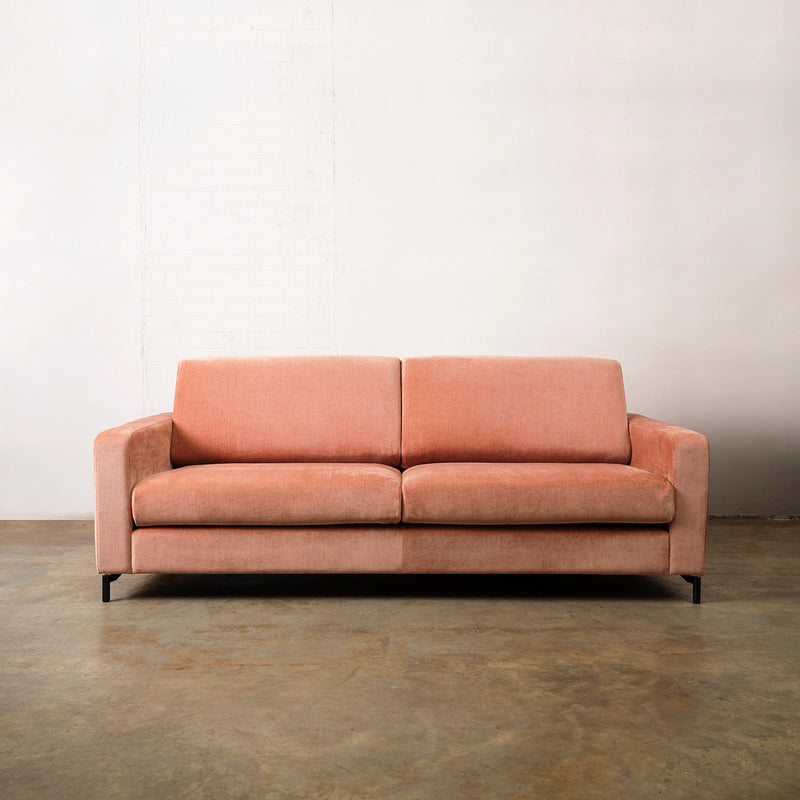
Chenille is a yarn, not a weave. Short lengths of fibre are bound to a twisted core so they stand out on every side — chenille is French for caterpillar, which is exactly what the yarn looks like. The result feels close to velvet but wears considerably harder, and it is one of the most misunderstood fabrics we work with.
The name comes from the French word for caterpillar — a reference to the fabric's fuzzy, textured surface which resembles the creature's soft exterior. That surface is not a finishing treatment but a structural feature of the yarn itself, which gives chenille its characteristic warmth, weight, and tactile richness.
Chenille has been used in upholstery for centuries. It fell out of fashion during the minimalist design movements of the late 20th century, but its warmth, comfort, and suitability for layered interior schemes have made it increasingly relevant again in contemporary design — particularly in living spaces that prioritise comfort and material quality over visual restraint.
How Chenille Is Made
Chenille begins as a yarn with an unusual construction. Short lengths of fibre — the pile — are trapped and twisted between two core threads that are then twisted together, locking the pile fibres in place perpendicular to the yarn's length. The result is a yarn that protrudes outward in all directions, resembling a pipe cleaner or — as the French observed — a caterpillar.
This pile yarn is then woven into fabric. The weave structure determines the density and direction of the pile, which in turn affects the fabric's weight, drape, and how the surface catches light. A tighter weave creates a more structured, durable fabric; a looser weave creates a softer, more flowing result with greater visual texture.
The pile fibres themselves can be made from cotton, acrylic, polyester, rayon, wool, or silk — or blends of these. The core threads are typically a stronger fibre like polyester or cotton. The combination of pile fibre and core determines the fabric's final character.

Weight Is a Quality Indicator
Heavier chenille generally indicates a denser pile and a more tightly constructed fabric — both positive indicators of quality and durability. When evaluating chenille, feel its weight in hand. A substantial, dense fabric will outlast a lighter, looser one significantly in upholstery applications.
Types of Chenille Fabric
Chenille varies considerably depending on the fibre used in the pile. Each type has a distinct character, performance profile, and ideal application.
Cotton Chenille
The most natural and breathable form. Soft, comfortable against skin, and excellent for warm climates. Absorbs moisture rather than repelling it, which makes it feel cool in summer. The pile can flatten with heavy use but recovers well. Requires more careful stain management than synthetic variants.
Acrylic Chenille
The most practical and widely used form in upholstery. Acrylic pile mimics the softness of natural fibres at a lower cost while offering significantly better stain resistance and colorfastness. More resistant to fading than cotton. The most common choice for everyday residential furniture.
Polyester Chenille
Highly durable, stain-resistant, and easy to clean. Less soft than cotton or acrylic but excellent for high-traffic environments. Resists pilling better than other variants. A practical choice for families with children or for commercial applications where cleaning ease is paramount.
Wool Chenille
The premium form — warm, naturally resilient, and with a depth of colour and texture that synthetic variants cannot match. Wool chenille is naturally flame-resistant, regulates temperature, and develops a beautiful character with age. More expensive and requires professional cleaning for significant soiling.
Rayon / Viscose Chenille
Very soft with a subtle sheen — the pile has a silkier appearance than cotton or acrylic chenille. Less durable than other variants and prone to crushing and matting with heavy use. Best for decorative or low-traffic applications where its visual quality is the priority.
Blended Chenille
The most common commercial form — typically cotton/acrylic or polyester/acrylic blends. Engineered to balance softness, durability, and ease of care. Performance varies by blend ratio; higher cotton content means softer but less stain-resistant; higher acrylic or polyester means more practical.
Look, Feel & Design Character
Chenille has a warmth and physical weight that few other upholstery fabrics can match. Unlike bouclé, whose texture is primarily visual, chenille's texture is experienced most fully through touch — the pile is extraordinarily soft and the fabric drapes with a satisfying weight that communicates quality immediately.
Visually, chenille has a subtle sheen that shifts gently with the direction of the pile, creating a quiet richness that rewards close attention without demanding it from across the room. It is less visually dramatic than velvet but more textured than a flat-woven fabric — sitting comfortably between the two in terms of visual impact.

Chenille is the fabric that people sit on and immediately notice — not because of how it looks but because of how extraordinarily soft and comfortable it feels. That's a rare quality in upholstery.
In terms of colour, chenille performs beautifully across the spectrum but is particularly effective in warm, rich tones — terracotta, rust, deep teal, forest green, burgundy, and warm neutrals. The pile adds depth to colour that flat fabrics cannot achieve. Lighter tones work well but show soiling more readily.
How Chenille Compares
Chenille sits in an interesting position among sofa fabrics — softer than most, more durable than it looks, and warmer in character than almost anything else. Here is how it compares to the other fabrics in this series.
| Fabric | Softness | Durability | Warmth | Stain Resist. | Best For |
|---|---|---|---|---|---|
| Chenille | Exceptional | Good–Very Good | High | Moderate | Comfort-led spaces |
| Bouclé | Very Good | Medium | High | Moderate | Textural statements |
| Velvet | Exceptional | Medium | Medium | Moderate | Colour & luxury |
| Linen | Good | Very Good | Low | Moderate | Warm climates |
| Microfiber | Very Good | Excellent | Medium | High | Practicality first |
Pros & Cons for Sofa Upholstery
Advantages
- Exceptionally soft and comfortable to touch
- Warm, rich appearance with subtle sheen
- Heavier weight gives furniture a substantial feel
- Natural variants age beautifully
- Works well in a wide range of colour palettes
- More durable than it looks — resists abrasion well
- Insulating — adds warmth in cooler climates
- Good acoustic properties — absorbs sound
Considerations
- Pile can flatten in high-use areas over time
- Susceptible to snagging and pulling
- Absorbs moisture — not ideal for very damp environments
- Lighter colours show staining more readily
- Some variants shed fibres initially
- Not ideal for cat owners — claws catch the pile
Where Chenille Works Best
Primary Living Room Sofas
Chenille's combination of softness, durability, and warmth makes it ideal for a family living room sofa. It is comfortable for extended use, holds its shape well under regular use, and creates a welcoming, lived-in atmosphere that more formal fabrics cannot.
Deep Sofas & Sectionals
The weight and softness of chenille is especially effective on deep-seated sofas and sectionals designed for lounging. The fabric invites the relaxed, comfortable use these pieces are built for.
Reading & Lounge Chairs
An excellent fabric for dedicated comfort chairs. The pile softness and warmth make chenille a natural partner for a chair that will be used for reading, resting, or extended sitting.
Bedroom Upholstery
Chenille's warmth and comfort make it a strong choice for bedroom ottomans, benches, and accent chairs. It contributes to the soft, layered aesthetic that makes a bedroom feel genuinely restful.
Climate Considerations
Chenille's insulating properties make it particularly suited to cooler climates or air-conditioned interiors. In very warm, humid environments without climate control, a lighter fabric such as linen may be more comfortable for prolonged contact use.
How to Care for Chenille Upholstery
Chenille requires straightforward maintenance. Its pile construction means some specific techniques are more effective than others — but the overall care commitment is moderate and entirely manageable with regular attention.
| Regular vacuuming | Vacuum weekly with a soft brush attachment at low suction, always working in the direction of the pile. This prevents dust from working into the base of the pile where it becomes harder to remove. |
| Pile flattening | Some compression in regularly used areas is normal. Lift the pile with a soft upholstery brush, or hold a steam iron several centimetres above flattened areas — never let the iron touch the fabric. |
| Spills | Blot immediately with a clean dry white cloth — never rub. Work from the outside edge inward. Cold water dilutes water-based spills; a dry-cleaning solvent handles oil-based stains. |
| Shedding | New chenille often sheds loose fibres for the first few weeks — this is normal and will stop. Vacuum regularly during this period; cut any loose fibres close to the base rather than pulling them. |
| Snagging | If a pile loop is pulled, work it back into the weave with a blunt needle rather than cutting it. Cutting creates a permanent bald spot. |
| Deep cleaning | Wool and cotton chenille benefit from annual professional cleaning. Synthetic variants can often be spot-cleaned with mild soap and water — always check the care label and avoid high heat. |
Is Chenille Right for Your Project?
Choose chenille if…
Comfort is your primary priority, you want a fabric that feels genuinely luxurious to sit on, and you want warmth and weight in the material. Chenille rewards daily use and creates a living space that feels inviting and comfortable rather than precious or formal.
Choose a synthetic or blended chenille if…
You have children, need easy stain management, or want the comfort of chenille without the care demands of a natural fibre variant. A quality acrylic or polyester-blend chenille offers 80–90% of the comfort with significantly greater practical resilience.
Consider an alternative if…
You have cats, live in a very warm or humid climate without air conditioning, or want a fabric that is completely effortless to clean. In these cases, a performance microfiber or tightly woven performance fabric will serve better in the long run.