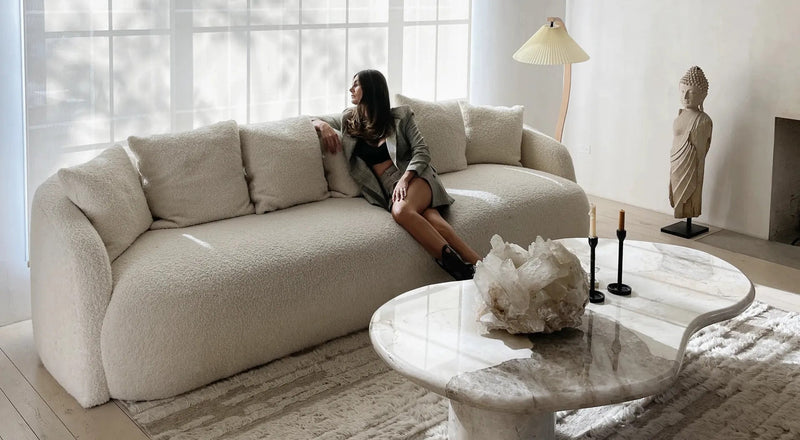
Bouclé is not a fibre — it is a construction. The yarn is spun with loops and curls that give the fabric its soft, nubby surface, and it can be made from wool, cotton, linen or polyester. Those same loops are why it snags. It has been a designer's material since mid-century modernism, and it is having a moment again now.
The name comes from the French word bouclé, meaning "curled" or "buckled." It describes a yarn — and the fabric woven or knitted from it — that has deliberately created loops, curls, or knots along its length. The result is a fabric with a distinctive three-dimensional surface unlike any flat-woven textile.
Bouclé has been used in furniture upholstery since mid-century modernism, when designers like Eero Saarinen and Florence Knoll used it to soften the hard lines of their architectural furniture. Its recent resurgence reflects a broader interior design shift toward warmth, texture, and materials that reward close inspection.
How Bouclé Is Made
Bouclé begins at the yarn level. A bouclé yarn is constructed from at least two strands twisted together at different tensions — a core yarn that provides structural stability and one or more effect yarns that are fed in more loosely, causing them to form loops and curls along the surface of the twisted strand.
The size, frequency, and regularity of these loops varies by yarn specification. Some bouclé yarns produce tight, uniform loops. Others are deliberately irregular — mixing small curls with larger loops and occasional knots — which creates a more organic, artisanal surface quality.
These yarns are then woven, knitted, or tufted into fabric. The weave structure affects the fabric's density, drape, and how prominent the texture appears on the finished surface. A looser weave amplifies the three-dimensional character of the loops; a tighter weave creates a more controlled, uniform surface.

Fibre Composition Matters
Bouclé is a construction method, not a fibre. It can be made from wool, cotton, linen, polyester, acrylic, or any blend. The fibre content determines the fabric's softness, durability, heat retention, and maintenance requirements. A 100% wool bouclé behaves very differently from a polyester-blend bouclé — even if they look similar at a glance.
Types of Bouclé Fabric
Bouclé is made in many different forms, each with distinct characteristics suited to different applications and aesthetics.
Wool Bouclé
The classic form. Natural warmth, excellent durability, and the richest texture. Develops a soft patina with use. Requires more careful maintenance — professional cleaning recommended for significant soiling.
Wool-Blend Bouclé
Wool combined with nylon, polyester, or acrylic. More durable and easier to maintain than pure wool while retaining much of its warmth and texture. The most practical option for everyday residential use.
Cotton Bouclé
Lighter and more breathable than wool. Less heat-retentive, which makes it a better choice for warmer climates. Slightly less textured than wool bouclé but more forgiving to clean.
Synthetic Bouclé
Polyester or acrylic-based. The most affordable option and the most stain-resistant. The texture is less nuanced than natural fibre variants and it does not age or develop character in the same way. A practical choice for high-traffic commercial use.
Chunky / Oversized Bouclé
Characterised by large, prominent loops and an exaggerated surface texture. Very fashionable in current interior design. Creates strong visual impact but the larger loops can snag more easily and may not suit households with pets or young children.
Micro Bouclé
Fine, tightly packed loops that create a more subtle texture — closer in appearance to a standard fabric from a distance but with beautiful surface complexity at close range. More durable and snag-resistant than chunky variants.
Look, Feel & Design Character
Bouclé has a warmth and approachability that few other upholstery fabrics can match. Its looped surface catches light differently depending on the angle of view, creating a fabric that appears to shift slightly as you move around a room.
In colour, bouclé works best in natural, earthy, and off-white tones that allow the texture to be the dominant visual element. Ivory, cream, oatmeal, warm grey, and camel are the most popular choices — they maximise the play of light across the surface. Bold colours are possible but can overwhelm the texture and create a less refined result.

Bouclé is one of the few upholstery fabrics that makes a room feel warmer simply by being in it. The texture reads as comfort before you even sit down.
Bouclé pairs naturally with warm wood tones, natural stone, linen, and unfinished metals. It sits less comfortably in very cool, industrial, or highly polished environments — though this contrast can be used deliberately to add warmth to an otherwise hard-edged space.
Pros & Cons for Sofa Upholstery
Advantages
- Exceptional visual and tactile texture
- Creates warmth and approachability in a space
- Works in both casual and formal settings
- Natural variants age beautifully with use
- Hides minor soiling better than flat fabrics
- Strong design impact — a statement material
- Pairs well with a wide range of interior styles
Considerations
- Loops can snag on jewellery, velcro, or pet claws
- Not ideal for households with cats
- Chunky variants require more careful cleaning
- Premium natural variants require professional cleaning
- Can pill over time with heavy use
- Less stain-resistant than smooth woven fabrics
Where Bouclé Works Best
Living Room Sofas & Sectionals
The ideal application. Bouclé's combination of visual warmth and physical comfort is perfectly suited to a living room centrepiece. It invites use and improves the longer it's owned.
Accent & Lounge Chairs
Particularly effective on chairs with curved or sculptural forms — the organic texture of bouclé complements organic shapes. A classic pairing used by mid-century designers to great effect.
Bedroom Benches & Ottomans
Excellent for lower-traffic pieces where texture is the priority and durability demands are lower. The softness of bouclé at the foot of a bed creates a cohesive, tactile bedroom environment.
Headboards
An underused application. Bouclé headboards introduce substantial visual texture to a bedroom without requiring pattern. Works particularly well in cream or warm grey tones against neutral walls.
Where to Use With Caution
We advise against bouclé for dining chairs (food and drink staining is harder to address on looped fabrics) or in households with cats whose claws will inevitably catch the loops. For these cases, velvet or a tightly woven performance fabric is a better choice.
How to Care for Bouclé
Bouclé is not a high-maintenance fabric but its texture requires slightly different handling than smooth upholstery fabrics. The loops mean that some particles — dust, pet hair, crumbs — can embed themselves more deeply than on a flat surface.
| Regular vacuuming | Weekly, using a soft brush attachment on low suction. Work in the direction of the weave to avoid disturbing the loops. This is the single most important care habit for bouclé. |
| Spot cleaning | Blot immediately with a clean, dry white cloth. Do not rub — rubbing will tangle and distort the loops. For water-based stains, a small amount of cold water on a cloth. For oil-based stains, consult a professional. |
| Pilling | Some pilling is normal with bouclé, especially in the first months of use. Use a fabric shaver (lint remover) to remove pills gently. Do not pull them by hand. |
| Deep cleaning | Professional upholstery cleaning is recommended for wool and wool-blend bouclé annually, or when significant soiling occurs. Avoid steam cleaning on natural fibre variants — heat can cause shrinkage. |
| Snagging | If a loop is pulled loose, do not cut it. Use a blunt needle or toothpick to gently push the loop back to the underside of the fabric. Cutting creates a hole that cannot be repaired. |
| Sunlight | Natural bouclé fabrics will fade with prolonged direct sunlight exposure, particularly in lighter colours. Position pieces away from south-facing windows or use UV-filtering window treatments. |
Is Bouclé Right for Your Project?
Choose bouclé if…
You want a fabric that creates a strong visual impression, you value texture over smoothness, your household doesn't include cats, and you are prepared for slightly more attentive care than a performance fabric would require.
Consider an alternative if…
You have cats, young children who will use the sofa heavily for messy activities, or if you need a fabric you can clean with minimal effort. In these cases, a performance velvet or tightly woven linen blend is likely a better match.
For the longest lifespan…
Choose a wool-blend bouclé with a micro or medium loop size over a large chunky loop. Tighter loops snag less, pill less, and hold their shape better over years of use without sacrificing the essential character of the fabric.